Sturbridge is best known for Old Sturbridge Village, and the town around it carries a matching housing stock — antique houses along Main Street and Route 131, farmhouses on the roads out toward the reservoir, and newer construction near the Route 20 and I-84 interchange where the tourism economy is concentrated.
Antique bathrooms are the town's characteristic glass project. In a house from the late eighteenth or early nineteenth century, the bathroom occupies space that was originally something else, and the surfaces around a shower have been settling for two hundred years. What that means in practice: an opening that is not the same width at the head as at the base, a ceiling that follows a roof pitch, a summer beam or a chimney chase interrupting a wall, and floors that are level only by coincidence.
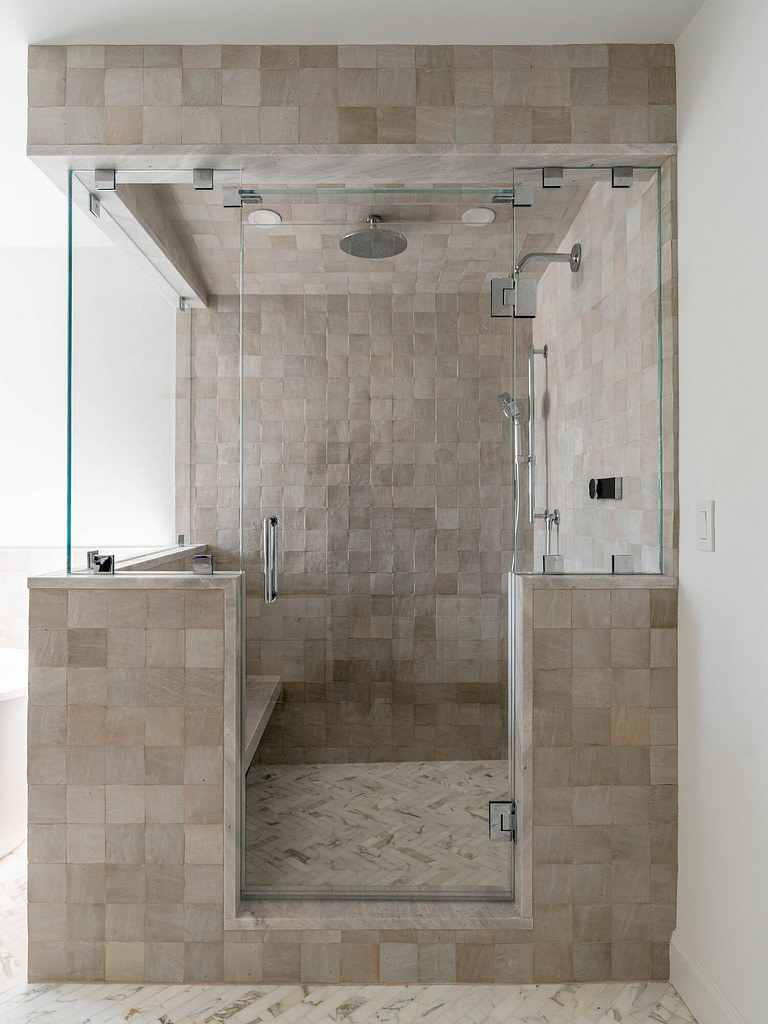
A stock enclosure has no answer for any of that. Glass cut to order does — angled at the top to follow the ceiling, notched to clear a beam, tapered to a leaning wall. We measure the finished opening in your home to 1/16" after the tile is complete, which is the only reliable way to know what an antique room actually presents.
There is an aesthetic argument as well. In a room with wide-plank floors, old trim, or exposed framing, a frameless panel with minimal hardware stays out of the way and lets the house be the point. An aluminum-framed enclosure reads as an appliance dropped into a historic room. Oil-rubbed bronze and unlacquered brass age comfortably in these settings; polished nickel suits the more formal Federal-era interiors.
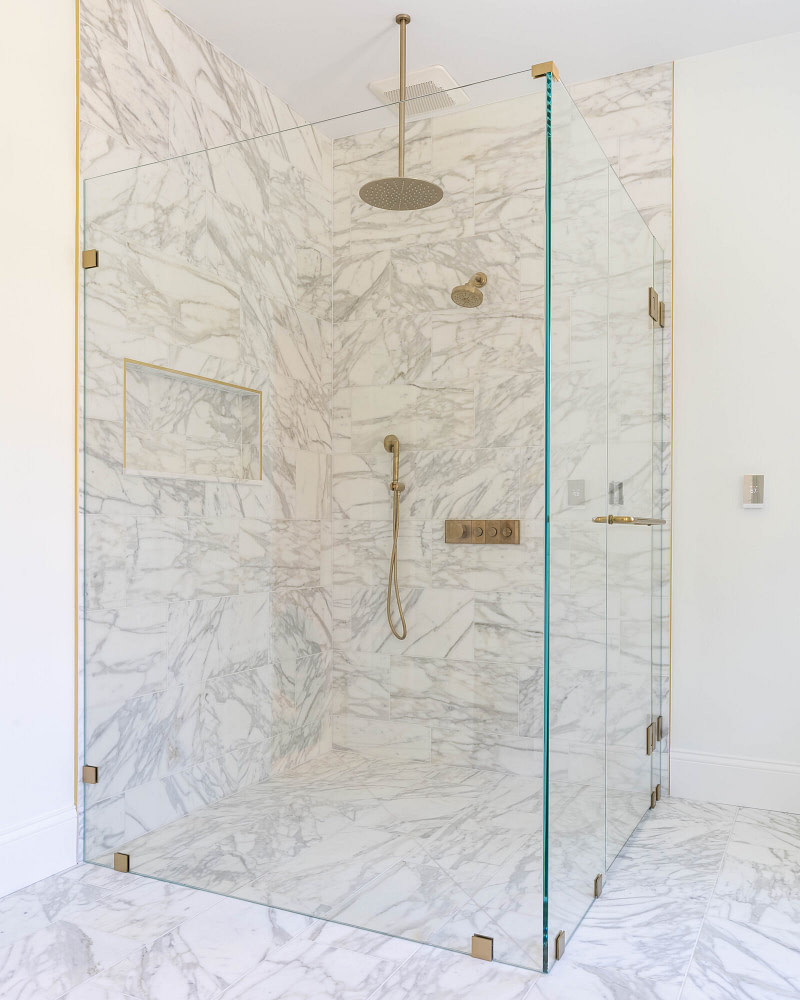
The newer housing near the highway brings conventional work — square framing, standard alcoves, and enclosures that are mostly a question of thickness and finish. Wider primary-bath renovations move the glass from 3/8" to 1/2", and low-iron ultra-clear glass is worth it against white marble or pale stone, where ordinary tempered glass shows a green tint at the edges.
Much of Sturbridge is on private wells, and hardness varies. A factory-applied protective coating slows mineral spotting considerably and must be ordered with the glass.
Sturbridge is served by our Feeding Hills showroom at 646 Springfield St, about 40 miles away — roughly a 60-minute drive via the Mass Pike or Route 20. That location is also our fabrication facility and headquarters, so your glass is made in the building you visit.
No part of a Sturbridge installation is subcontracted — our consultant measures it, our Massachusetts shop builds it, and our installers fit it, at the quoted price.