Newburyport is a Federal-era seaport that has been carefully restored rather than rebuilt, and that history defines its bathrooms. The High Street and downtown districts hold one of the finest concentrations of Federal architecture in New England — clipper-captain houses, brick townhouses, and merchant homes from the late eighteenth and early nineteenth centuries — and the bathrooms inside them are almost never original to the plan.
Federal-period houses present a particular challenge: their upper-floor bathrooms are frequently compact and sit under sloped rooflines, carved out of former bedrooms, dressing rooms, and stair halls. Ceilings slope, sometimes in two directions. Chimney chases and low beams interrupt wall surfaces. Two centuries of settling means openings lean and walls bow, and an opening can vary half an inch or more from base to head.
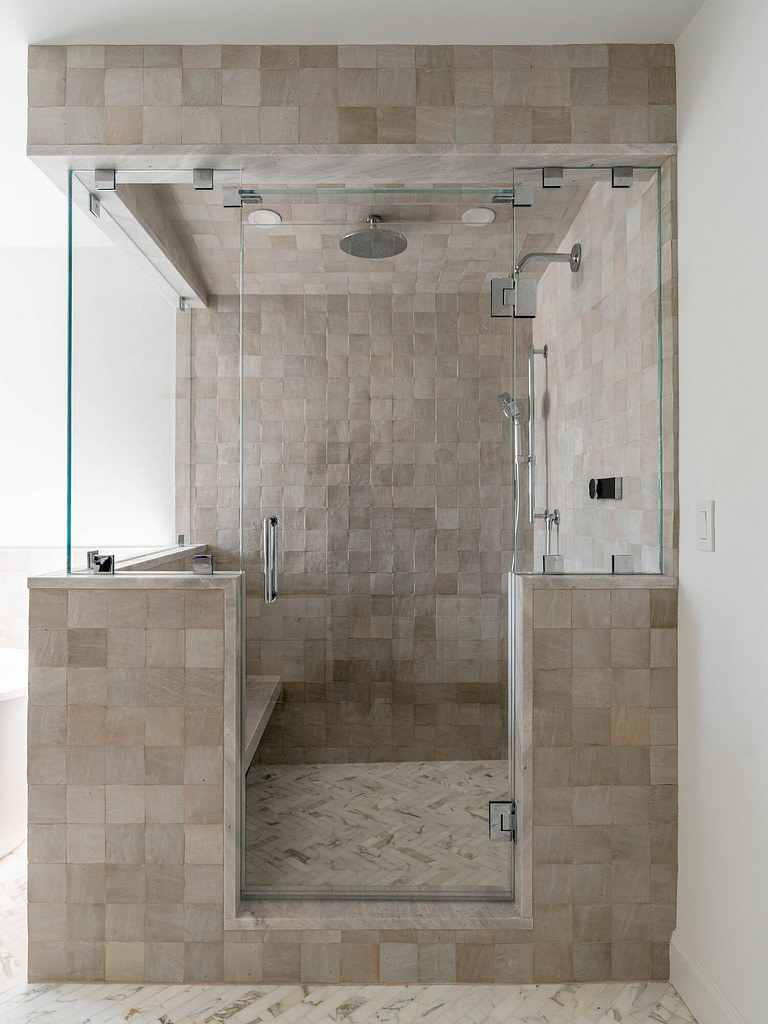
That is custom-glass territory in the strictest sense. Every Oasis enclosure is measured in your home to 1/16" after the tile is complete and cut to the geometry that exists — angled top cuts where a ceiling slopes, notches to clear a casing, a beam, or a chase, and panels sized to a wall's actual taper. A stock enclosure cannot address any of it, and in a room with original detail the difference between a panel that sits flat and one that shows a wedge is immediately visible.
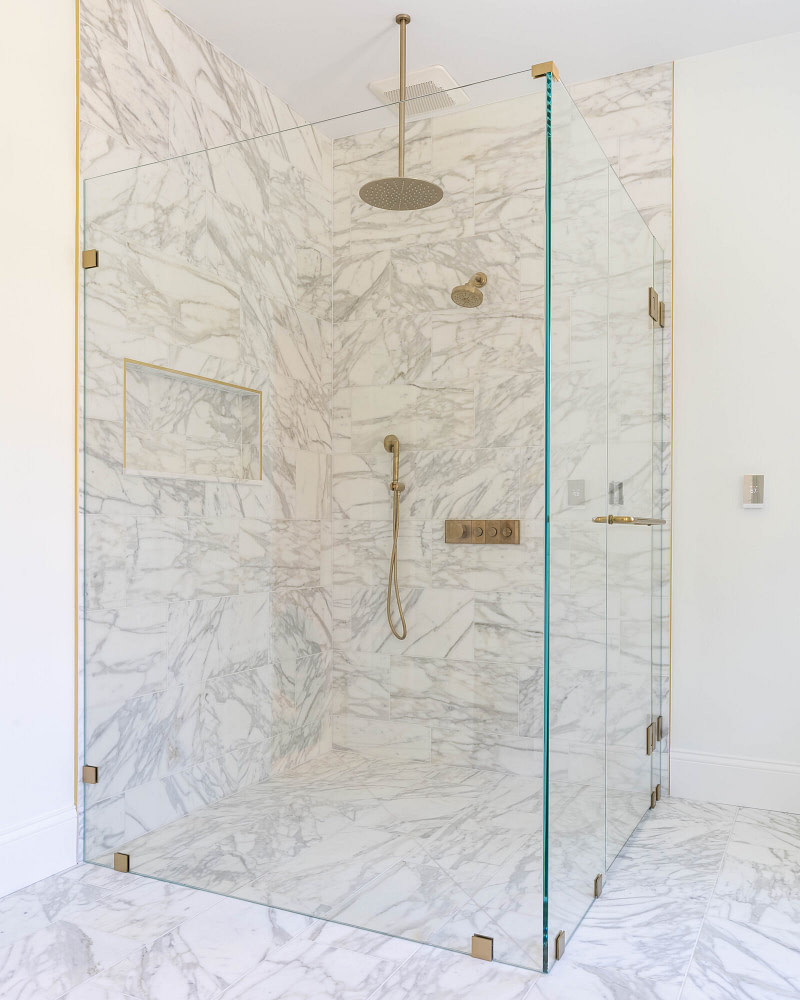
Restraint tends to be the right instinct in these houses. Where a bathroom retains period proportion or original millwork, a frameless panel with minimal hardware lets the room read as itself instead of putting a metal frame at its center. Polished nickel, unlacquered brass, and oil-rubbed bronze sit correctly alongside period fixtures, and matching an existing finish is far more reliable with the actual piece in hand than from a photograph.
Newburyport's newer construction and its converted mill and waterfront properties go the other direction — more regular framing, sometimes larger primary suites supporting wide walk-ins with fixed returns and benches. Those spans move the glass from 3/8" to 1/2" for rigidity and door feel. Low-iron ultra-clear glass is worth the upgrade against white marble or pale stone.
Proximity to the water is worth a word on hardware: salt air weathers finishes differently than inland conditions, and exposure matters more for houses near the waterfront and out toward Plum Island.
Our Peabody showroom at 47 Newbury St is about 24 miles from Newburyport, roughly a 35-minute drive down Route 95 or Route 1.
Oasis employees do all of it for Newburyport customers — the measurement, the Massachusetts fabrication, the installation — with no change to the quoted price.