Longmeadow is the Springfield area's most established suburb, and its housing shows it: a National Register historic district of grand colonials, Tudors, and Georgian Revival houses along Longmeadow Street and around the town green, plus substantial twentieth-century development through the neighborhoods off Williams Street and Converse Street.
Grand older houses tend to renovate several bathrooms at once, and that is worth planning deliberately. Ordering multiple enclosures together keeps hardware finishes genuinely consistent across the house — harder to achieve than it sounds if the baths are done a year apart and a finish gets revised or discontinued in between — and it lets measurement and installation be coordinated rather than repeated.
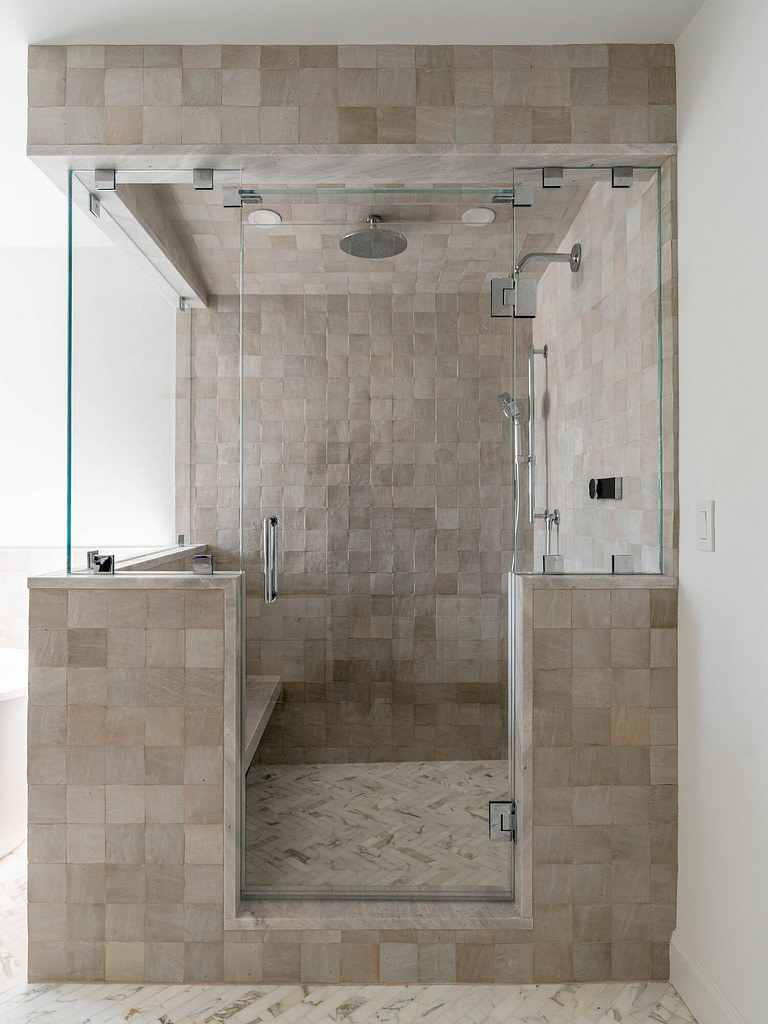
The houses themselves bring the conditions that come with age. Bathrooms in 1920s and 1930s construction are compact and were fitted into rooms not designed for them; upper-floor baths sit under sloped ceilings; framing has moved enough over ninety-odd years that openings lean and walls bow. Glass cut to a nominal size will show a wedge at one end. Every Oasis enclosure is measured in your home to 1/16" after the tile is complete and cut to the actual geometry, with angled top cuts and notches around casings, beams, and old radiator lines as routine work.
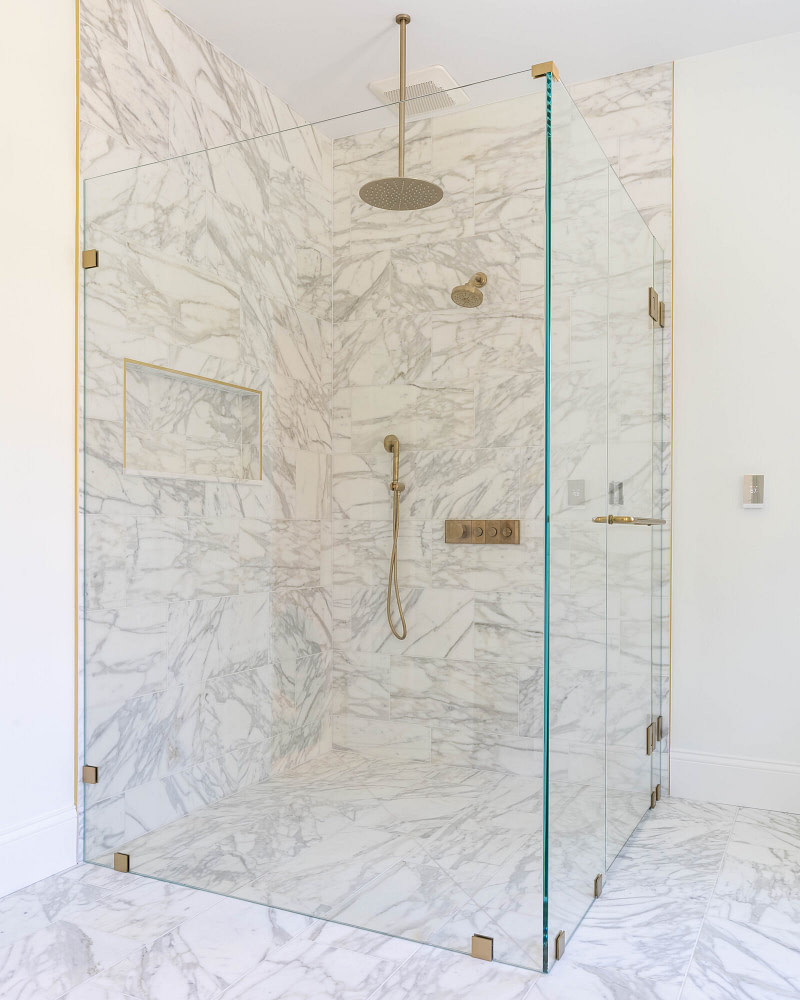
Architectural character drives hardware here more than in most towns. Tudors and Georgian Revival houses tend toward polished nickel, unlacquered brass, and oil-rubbed bronze, usually chosen to sit alongside plumbing fixtures already in the room. Matching an existing finish is far more reliable with the actual piece in hand than from a photograph, since the same nominal finish varies noticeably between manufacturers.
Where a Longmeadow renovation takes space from an adjacent room to build a proper primary suite, the resulting enclosure can be substantial — a wide walk-in with a fixed return, a door, and often a bench. Those spans push the glass from 3/8" to 1/2" for rigidity across a long run and a more solid door swing. Low-iron ultra-clear glass is worth the upgrade against white marble or pale limestone, since standard tempered glass carries a green cast at the exposed edges.
Longmeadow is served by our Feeding Hills showroom at 646 Springfield St, about 7 miles away — roughly a 10-minute drive. That location is also our fabrication facility and headquarters, so your glass is made in the same building you visit, which keeps turnaround tight and questions easy to answer.
No part of a Longmeadow installation is subcontracted — our consultant measures it, our Massachusetts shop builds it, and our installers fit it, at the quoted price.