Littleton spent a century as apple country and the last thirty years becoming an I-495 tech address, and both are still visible — orchards and nineteenth-century farmhouses along Great Road and King Street, with subdivision housing from the 1990s and 2000s filling the wooded land between them.
The newer houses generate most of the bathroom work, and the project is almost always the same one. Primary suites from that era were laid out around a soaking tub set into a corner platform, with a separate shower squeezed in beside it — typically a stall about three and a half feet wide with a framed door. The tub gets used rarely enough that most owners can name the last time. Reclaiming that platform for the shower roughly doubles the usable space.
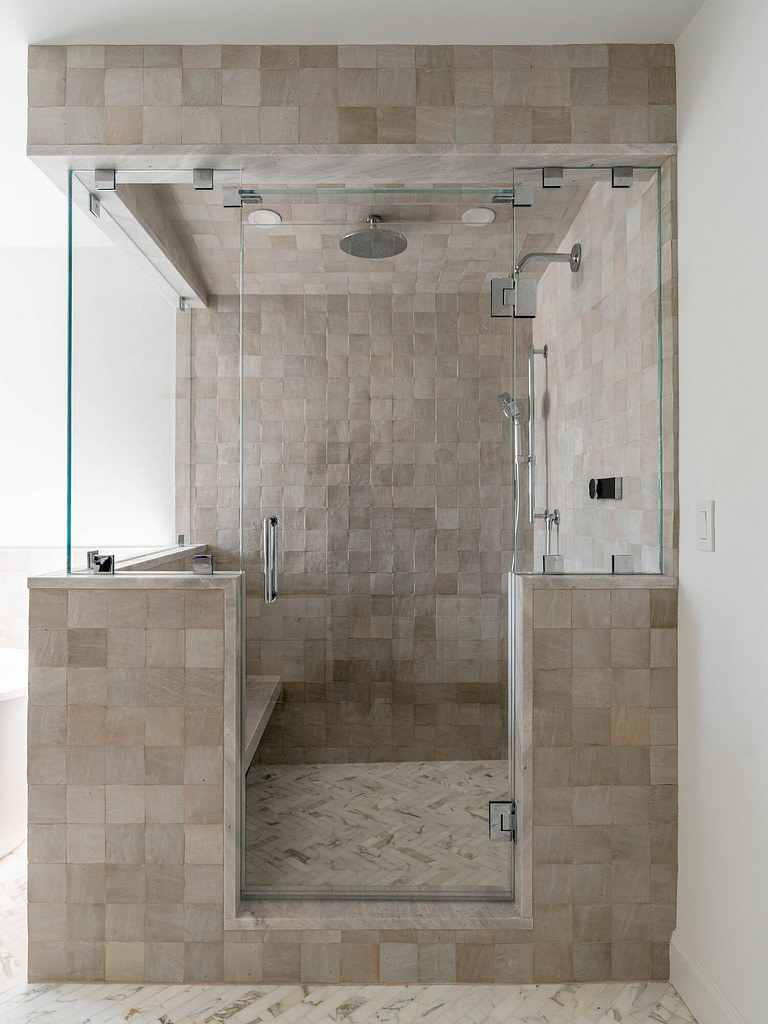
What makes it a custom-glass job rather than a purchase is the shape left behind. Remove a corner tub and you do not get a rectangle; you get an opening with a stub of wall returning where the deck met the tile, and frequently a corner running at forty-five degrees. Panels have to be cut to those angles, joined at the corner, and notched where a bench or a recessed shelf interrupts them. The measurement for all of that is taken in the room after tiling is finished, to 1/16", because the shower as built and the shower as drawn are never quite the same object.
Span drives thickness more than anything else does. Under about four feet, 3/8" glass is right. Beyond that a fixed panel benefits from 1/2" — thin glass across a long run will hold a slight curve, and once you have noticed it you will keep noticing it.
Littleton's farmhouses are the opposite job. Bathrooms in nineteenth-century houses sit in rooms that were something else first, under ceilings that follow the roof, with framing that has been moving since before the Civil War. Glass for those gets an angled top edge and cutouts around whatever the room contains.
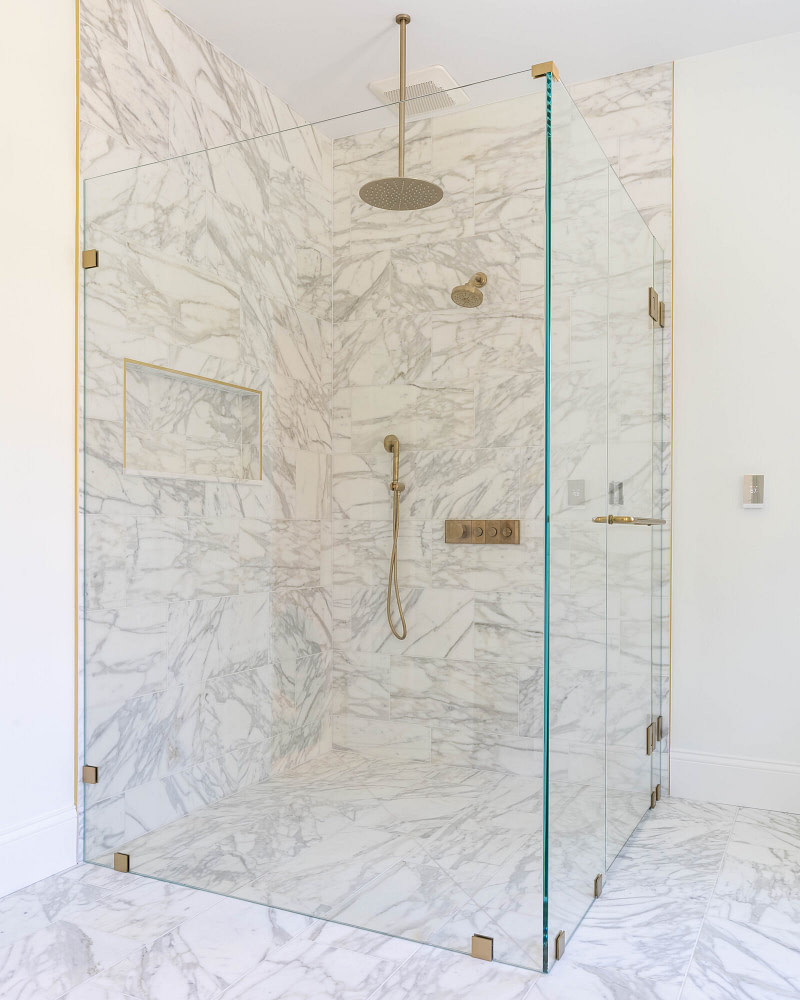
For tile in white marble or a pale quartzite, low-iron glass is worth the modest premium — the standard product carries a green tint at the cut edge that shows against light stone. Finishes here are mostly brushed nickel and matte black.
Some of the town is on well water, where a factory-applied coating meaningfully slows mineral spotting.
Our Needham showroom at 33 Highland Ave is 27 miles off, about 40 minutes via I-495 and Route 128. Bring tile and, if you are matching a faucet, the faucet.
Oasis handles all of it directly — our consultant, our Massachusetts shop, our installers — at the quoted price.