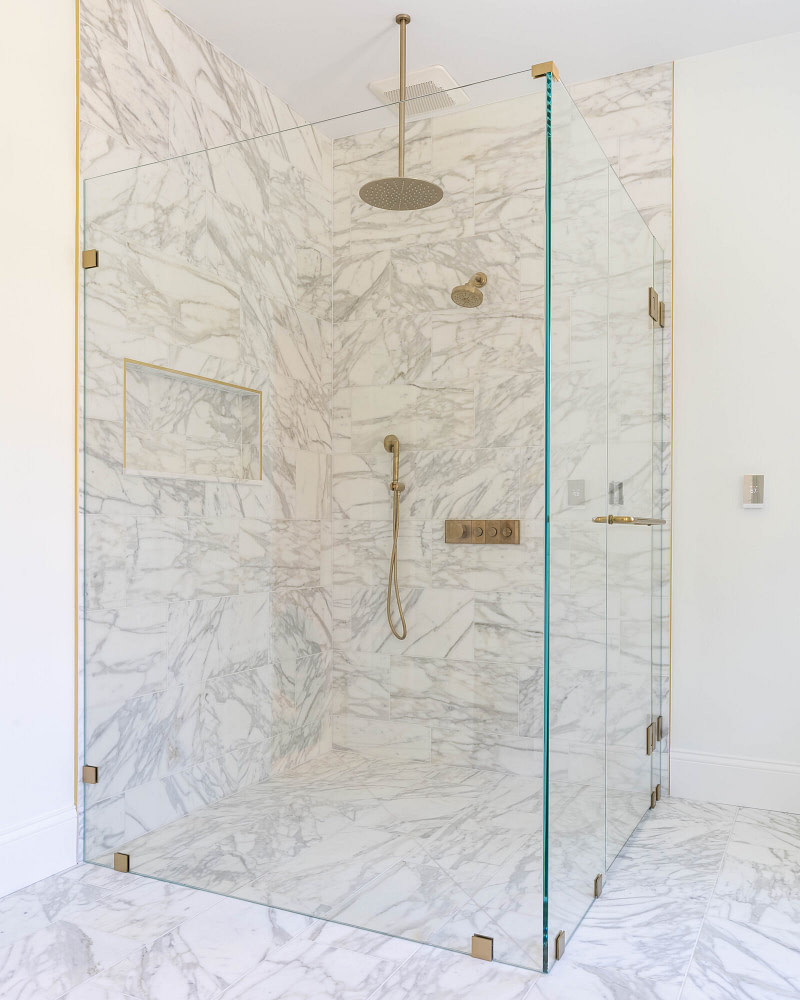
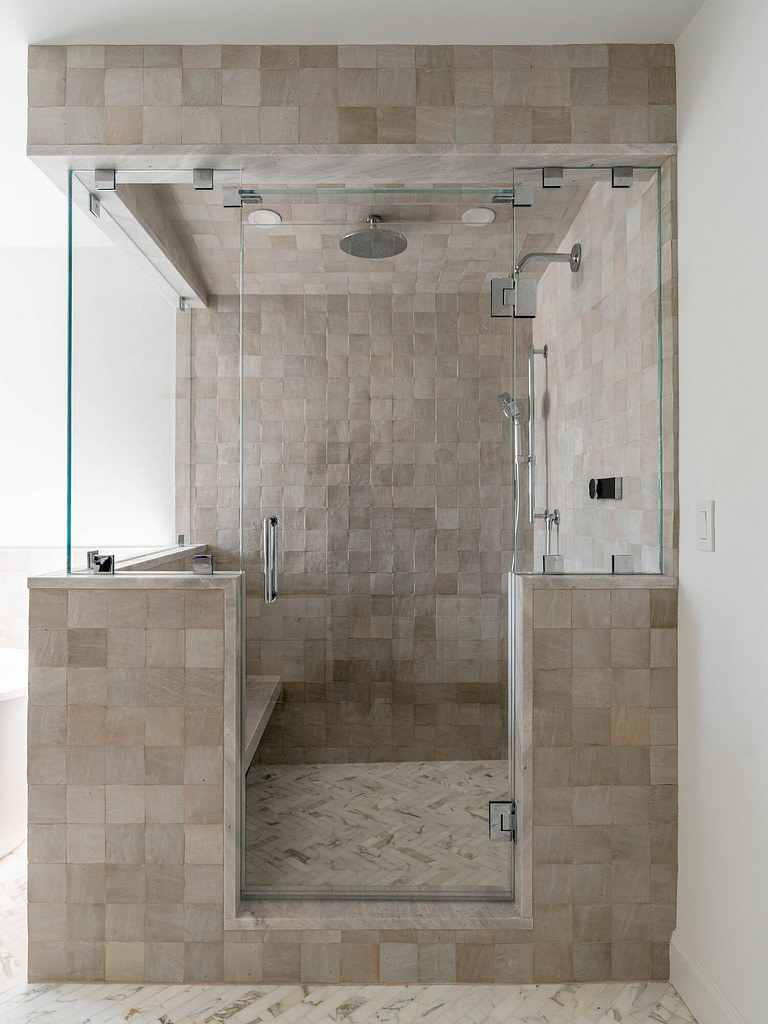
Holliston has neighborhoods from essentially every decade since the 1950s arranged around a classic downtown, which means the town contains the full range of bathroom problems in one place — 1950s and 1960s capes with compact tiled baths, 1970s and 1980s colonials with standard tub alcoves, and 1990s and 2000s construction with corner tubs and separate stalls.
Each era gets a different project. The oldest housing usually needs a full rebuild: original tile, an alcove tub, and framing that has moved enough over sixty years that the opening is no longer square. The most common outcome is a tub-to-shower conversion, and the glass has to be cut to the alcove's finished width — a dimension fixed by studs placed decades ago that is essentially never a round number. We measure it in your home to 1/16" after the tile is set.
The 1970s and 1980s colonials typically have a serviceable layout and a dated enclosure, often a framed slider or a swing door with aluminum on all four sides. Replacing that with frameless glass changes the room more than the price difference suggests: no perimeter framing, no bottom track collecting deposits, and the tile becomes what you see. The requirement is precision, since a frameless panel has no frame to absorb a discrepancy.
The newest housing brings the corner-tub-and-stall primary bath, where removing the tub and expanding the shower produces a genuinely better room. The resulting opening is defined by the old tub deck and existing walls — rarely standard, often with a return leg or angled corner — and custom fabrication handles that geometry directly.
Across all three, wider openings move the glass from 3/8" to 1/2" for rigidity across a long fixed run and for a heavier, better-damped door swing. Low-iron ultra-clear glass is worth the upgrade where the tile is white marble or pale porcelain, since standard tempered glass shows a green cast at the exposed edges.
Hardware in Holliston runs toward brushed nickel and matte black, with brushed brass increasingly common in fuller renovations, and toward polished nickel or oil-rubbed bronze where an older house has fixtures to match. Matching an existing finish is far more reliable with the actual piece in hand than from a photograph.
Our Needham showroom at 33 Highland Ave is about 16 miles from Holliston, roughly a 25-minute drive via Route 16 and Route 128 or across Route 126. Close enough to visit twice as a design develops.
A Holliston installation means two Oasis visits and fabrication in between at our own Massachusetts facility, all covered by one fixed price.