Harvard's building stock is unusually old for a town that has kept growing. Eighteenth- and nineteenth-century farmhouses line Old Littleton Road, Ayer Road, and the streets around the Common and Still River, and many have been restored rather than replaced. The rest of the town is large-lot custom construction on wooded acreage, much of it built since the 1980s.
Antique houses set the harder problem. Their bathrooms were never part of the original plan — they were carved out of bedrooms, closets, and back halls long after the frame went up — and two centuries of settling means openings that lean, plaster and tile that follow the framing, and ceilings that slope under the eaves. A stock enclosure cut to a nominal size will not sit correctly in a room like that; the gap shows on one side and no amount of caulk hides it. Custom fabrication solves it by measuring the finished opening in your home to 1/16" and cutting glass to the actual geometry, including angled top cuts where a ceiling slopes and notches where a panel has to clear a casing, a beam, or an old radiator.
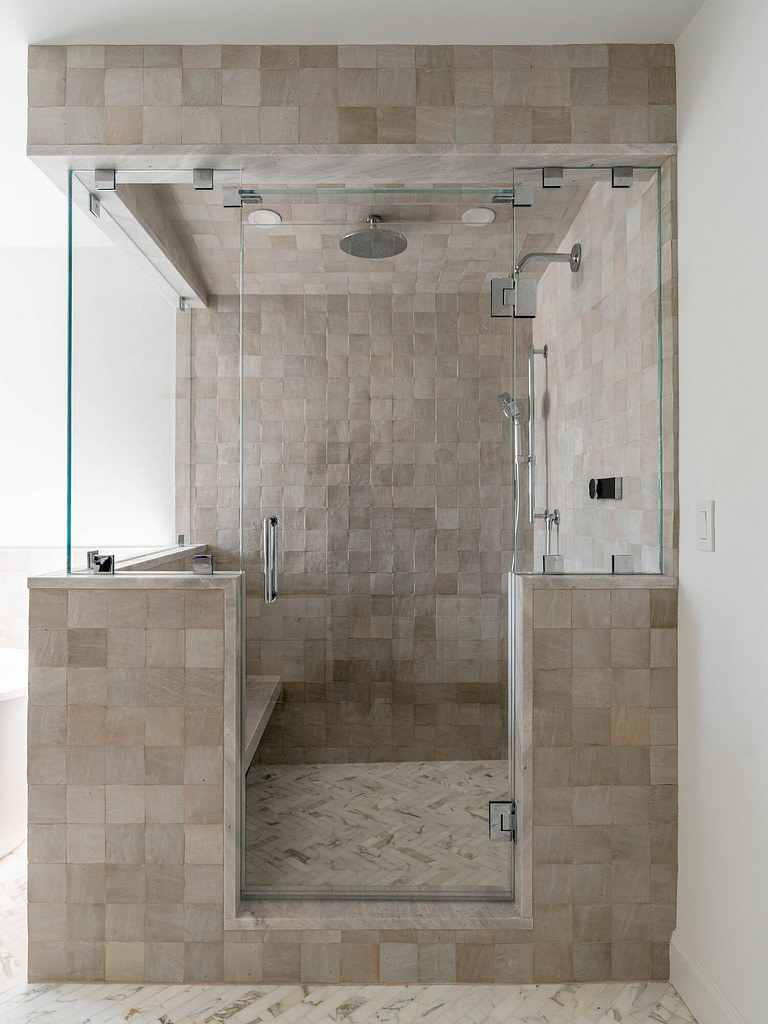
The newer custom homes bring the opposite condition: generous primary suites with room for a wide walk-in, a fixed return panel, a bench, and sometimes a curbless entry. At those spans, 1/2" glass is frequently the better choice over 3/8", holding a long fixed run flatter and giving a larger door a solid, damped swing.
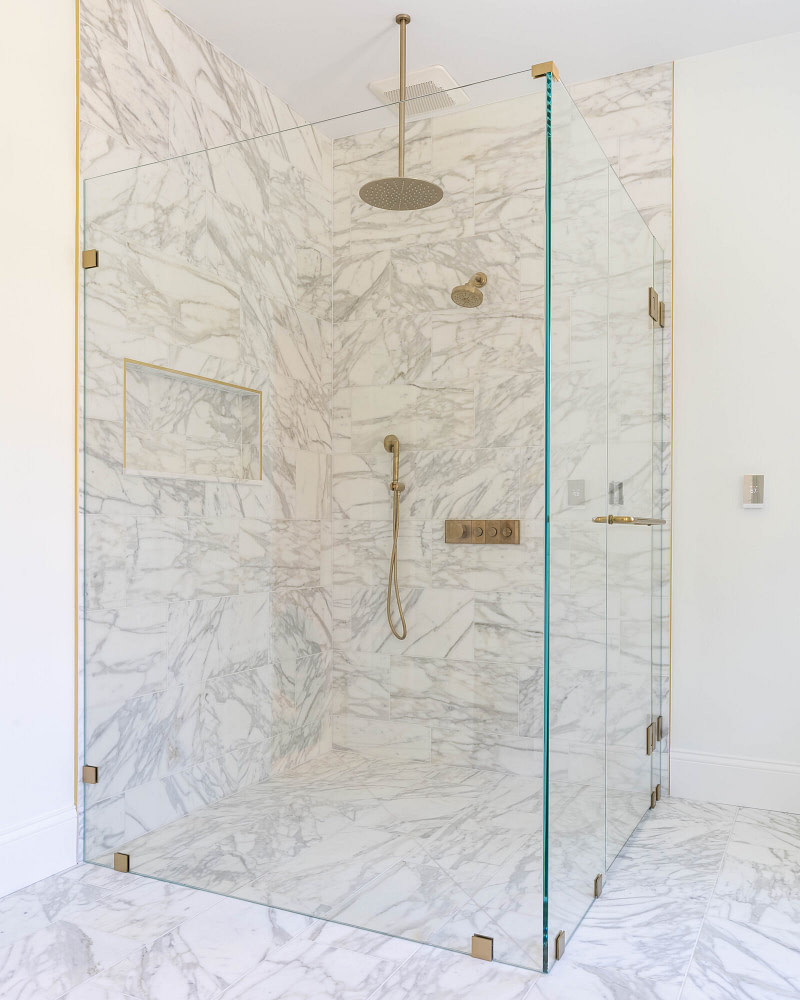
Low-iron ultra-clear glass is worth considering on either type where the tile is white marble, honed limestone, or pale quartzite — standard glass carries a faint green cast that reads at the edges against light stone, and low-iron removes it. In restored antique baths, hardware usually stays traditional: polished nickel, unlacquered brass, or oil-rubbed bronze, chosen to sit correctly alongside period-appropriate fixtures. Newer construction in Harvard runs toward matte black and brushed brass.
Nearly all of Harvard is on private wells, and water hardness varies considerably across town. Protective glass coatings come up more often here than in town-water communities. A coating does not eliminate mineral spotting, but it slows it noticeably and makes routine squeegeeing far more effective.
Our Needham showroom at 33 Highland Ave is about 29 miles from Harvard, roughly a 45-minute drive by Route 2 and Route 128 — enough of a trip that it is worth making it count. Bring your tile sample and, if you are matching existing fixtures, the actual finish rather than a photograph.
We handle Harvard projects end to end with our own staff: in-home measurement, fabrication at our own facility, and installation, all for a quote that is final.